
 By
·
3 minute read
By
·
3 minute read
In 2025, Whisp Drive entered a nine-month pilot with Mazda.
For us, this was an important moment.
Dealerships spend an enormous amount of money getting shoppers to their websites.
-
SEO
-
Paid search
-
Social media
-
Third-party listings
-
OEM advertising
-
Digital retailing
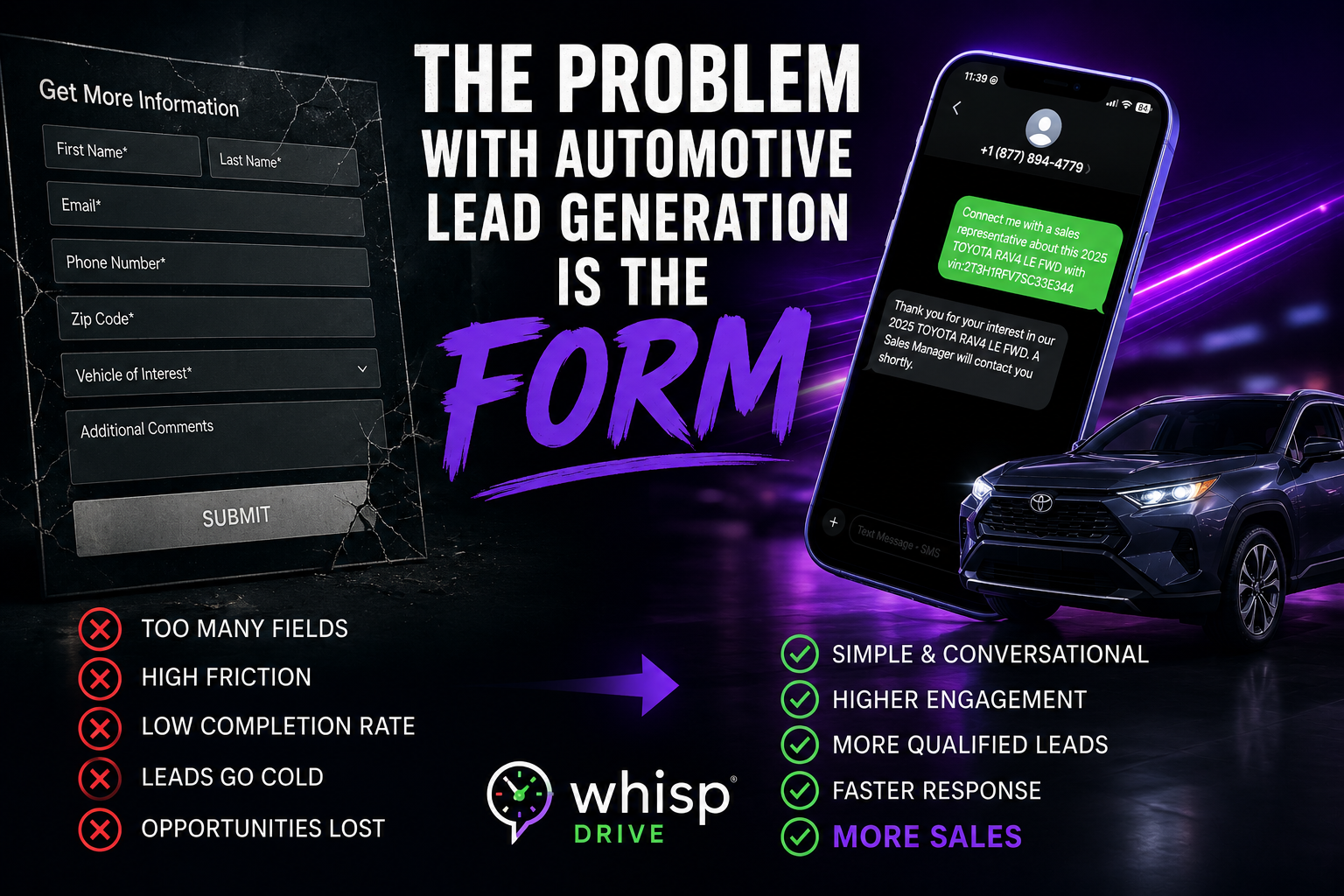
All of that investment is designed to accomplish one thing: get a potential buyer onto the dealership’s website. Then we ask them to fill out a form. We believe that’s where one of the biggest problems in automotive lead generation begins. .
Forms Create Friction
Think about the way consumers interact with almost everything else online today. Amazon made one-click purchasing normal. Apple Pay eliminated the need to repeatedly enter information. Apps automatically remember who we are. Consumers have been trained to expect fast, simple digital experiences. Yet automotive lead capture still frequently asks shoppers to stop what they’re doing and manually enter their name, email address, phone number and other information into a form. Every additional field creates friction. And every additional step gives the customer another opportunity to leave. But abandonment isn’t the only problem with forms. There is another problem that may be even more expensive.
A Completed Form Doesn’t Necessarily Mean a Reachable Customer
Traditional forms depend on the customer manually entering accurate information. Sometimes they do. Sometimes they make a mistake. And sometimes a shopper who wants information but doesn’t want a salesperson calling them simply enters a fake phone number or email address. From the dealership’s perspective, the reason doesn’t really matter. The lead still enters the CRM. Someone still has to work it. And the dealership may not discover that the contact information is bad until a salesperson or BDC representative has already spent time calling, texting and emailing someone they were never going to reach. How big is this problem? A recent BYD Europe case study provides an incredible look at what happens when automotive lead data is examined at scale.
More Than 60,000 Invalid Entries
BYD Europe worked with automotive marketing platform Driftrock to manage and validate leads as the company expanded across 15 European markets. In 2025, the system generated 591,006 leads. Of those leads, 60,608 contained invalid phone or email information and were automatically filtered out. That’s 10.26% of the total lead volume. (Driftrock) Think about what that means. More than 60,000 leads that could have potentially reached sales teams contained invalid contact information. BYD and Driftrock specifically identified lead validation as critical to making sure contact centers and dealerships spent their time working contactable prospects. (Driftrock) This isn’t a theoretical problem. It’s happening at massive scale in automotive.
Bad Data Has a Cost Beyond the Lost Lead
The obvious cost of bad information is that you can’t reach the customer. But we believe the larger cost is what it does to the sales organization. Imagine being a BDC representative receiving 100 leads. You don’t know which ones contain accurate information. You call one. Disconnected. Call another. No response. Send an email. Bounce. Call again. Eventually something happens.
You start believing the leads are bad.
And when salespeople stop believing in the quality of their leads, effort changes. Response time slows. Follow-up becomes less persistent. Morale suffers. And now the bad leads aren’t just wasting time. They’re affecting how your team works the good leads.
We Built Whisp Drive Around a Different Idea
What if we didn’t depend on the customer manually typing their phone number into a form in the first place? Whisp Drive uses SMS as part of the lead-capture process. Instead of asking the shopper to complete a traditional form, our two-tap process helps verify the customer’s mobile number before the lead reaches the dealership. That changes the equation. The dealership gets an accurate mobile number. The lead arrives in real time.
And most importantly, the customer’s phone is still in their hand when the lead is created. They’re not just a record sitting in a CRM.
They’re a shopper who was looking at a vehicle moments ago and has just raised their hand.
Maybe We Don’t Need a Better Form
The automotive industry has spent years trying to optimize forms. Shorter forms. Better-looking forms. Different CTAs. Fewer required fields. All of those things can help. But eventually we started asking a different question:
-
What if the problem isn’t how we’re designing the form?
-
What if the problem is the form itself?
That’s the idea behind Whisp Drive. We’re not trying to build a better automotive lead form.
We’re building an alternative to it.